|
May 27, 2012 — 2:01 pm
This post is part of my stated goals mentioned here.
Years ago, I could read, write, listen to, and speak Mandarin Chinese rather well. Well, by “rather well,” I mean at a level which would allow me to survive if I were dropped off in the middle of Beijing at any given moment.
Sadly, those skills have atrophied. It’s common knowledge (at least, conventional wisdom dictates) that language skills are highly perishable, in that they decrease significantly the less you use them. Fortunately, in my case anyway, it seems that once the initial difficult work of learning the basics of the language have been mastered, the process of reacquiring those skills are not incredibly arduous. I gleaned this fact when I traveled to China last August. Though I was extremely rusty and more than a little embarrassed, I found that within a few days in country, I could walk up to a ticket window, make inquiries and purchase rail tickets with little difficulty. I pride myself on this because it’s a well known inside joke among those who know Chinese culture how convoluted and backwards rail travel can be.
Anyway, I’ve been informed that if I wish to advance professionally within my work role, I must increase my Chinese proficiency; which means I need to take the Defense Language Proficiency Test within the next year. I’m not willing to take any classes outside of work to reach this goal, as my free time is severely limited. That leaves me with somewhat limited options.
One of those options is ChinesePod, which is an extensive Chinese podcast offering hundreds of lessons in tiered difficulties. If you are just starting out, you’d be at the basic level. Next is Elementary, then Intermediate, Upper Intermediate, and then Advanced. Also offered are supplementary PDF files which go over all the vocabulary and grammar necessary to understand each lesson.
When I first dove back into this, about two weeks ago, I went immediately for the Intermediate level, which deals more with everyday conversations one might have (or overhear) while visiting or working in China. Unfortunately, I quickly found that what was being said (and how fast it was being said) was above my comprehension skills. The vocabulary was off just enough where I was only catching about 50% of the conversation. To complicate matters, the explanation about what is going on in the conversations is also done in Chinese.
I have a way of approaching the learning of new materials (whatever it may be) which is cognitively dissonant. This is a very common theme throughout my life, and I’ve never been able to figure out how to defeat it. When I approach a new subject (or try to learn something new or more difficult in a subject I know), I always assume that the material will come to me intuitively. That is, I just wade into it and expect to just “pick up” what I need easily. When that doesn’t happen (and it only does about 25% of the time), I get frustrated, embarrassed, and mad at myself for not just “knowing” the material.
This, of course, is crazy. I should know that I won’t just “pick up” the knowledge I want to gain intuitively, and I should further know that getting frustrated about it is just…silly.
But, that’s how I work. It’s always been that way.
I think there are several factors at play, here. I’m certain there’s a bit of the Dunning Kruger effect going on. I go into a subject assuming I’m more knowledgeable than I really am and expect my brain to act accordingly. Again, this is silly. It’s only when you’re quite good at something that you recognize how much you suck at it. It makes no sense to approach a subject you know you’re sub-par at and make the assumption that you’re actually quite good.
Impatience is probably also a factor. I’ve gotten much better at this over the years. I’m able to focus longer and with more clarity than in the past. Some of that has to do with just living life. Most of it has to do with working at it, consciously.
Anyway, all of that is a rather long way of saying that I pretty much suck at Chinese. I’ve been forced by the limits of my comprehension to drop from Intermediate down to Elementary lessons. So, now I’m in the realm of facial features, shopping for shoes, catching a bus, getting directions, etc…
And, that’s fine. It was embarrassing at first, but I’m relearning the fundamentals of the language. There are nuances I’ve forgotten about, sentence patterns I’ve neglected, and vocabulary words I’ve never heard before.
I’ll be back up to Intermediate level in no time.
|
|
|
May 26, 2012 — 9:20 pm
This post is part of my stated goals mentioned here.
Back about 12 or 13 years ago, I picked up The Sound and the Fury by William Faulkner because I decided it was about time I gave him a whirl. Having never read Faulkner before, I had no idea what I was in for, other than the assorted murmurs I picked up from time to time about how difficult of an author he was to read. Those murmurs proved to be completely founded, as I got about 10 pages in and set it down in frustration, not to be picked up again for nearly a decade.
It was a friend at work who convinced me to give Faulkner another try (after we had a very in-depth discussion about Thomas Pynchon), but he advised that I start with something a little less daunting. I held off until I went down to Jazz Fest in New Orleans in 2010, where I bought Collected Stories from the William Faulkner House located in Pirate Alley (right behind the Saint Louis Cathedral). It may sound hackneyed, but I took the book around the corner, sat in an open-air bar, ordered a Scotch and began reading. I’ve never looked back.
The Reivers is the 8th Faulkner novel I’ve read (not to include Collected Stories or other short stories). The Sound and the Fury is well behind me, as is Light in August, As I Lay Dying, and Intruder in the Dust. I may write about those novels later (The Sound and the Fury is probably the second best book I’ve ever read, behind Lolita).
I mention those novels because The Reivers stands apart from them, not in substance, but in style. Published in 1962, it was Faulkner’s last novel, and probably one of his most accessible. There is little to no stream of consciousness flowing through the narrative. Gone, too, are the long, but breath-taking descriptive paragraphs found in his earlier works.
What’s left is a pretty straight-forward book of dialoge between three main characters, and about a dozen ancillary players. There’s little left to the imagination about plot or motivation, and the reader can take it pretty easy reading through the pages.
I don’t stand with other critics who call this one of Faulkner’s “lesser works,” however. Even stripped down, it’s a better piece of work than most contemporary authors produce; for one, simple, yet universally true reason: Faulkner understands the human condition better than anyone I’ve ever read.
I’m no good at writing a synopsis of anything, really. The Wikipedia article will probably do a better job at giving you an idea of what the book is about than anything I write. In the end, it’s a comedy. There’s nothing “soul-crushing” about it. I found myself surprised and chuckling continuously throughout, and was grateful for a “light” read. But, it has all the elements of something much more “heavy” and engaging. The ever-present racial and social undertones are there: The hard, dirt life of Mississippi dirt farmers; The stupidity, meanness, and pettiness of power-mad authority figures; Women who have no choice in life but to sell their bodies to those who will buy them for a night…it’s all there.
The big takeaway, in my view, is the biblical story (I’m thinking Eve, here) of the loss of innocence of an eleven year old boy, how he mourns at that loss, and how he finally learns to accept it. It sounds shlocky, but it turns out to be rather touching in the end.
If you haven’t guessed by now, one of my goals is to read every book by Faulkner. I figure I’m about half way there. The two other Faulkner books I have in the queue for this year are Soldier’s Pay and Pylon.
Next up, however, is Camille Paglia’s Sexual Personae. At nearly 600 pages, I hope to blog about it as I work through it so I don’t have to save up all my thoughts until the end.
|
|
|
May 23, 2012 — 1:38 pm
I have too much stuff.
In particular, I have too much stuff going on in my head.
Well, maybe that’s not right. Perhaps I have just the right amount of stuff going on up there and I’ve been thus far unable to organize it. Perhaps upon a well thought out organization, I will discover that I have far too little going on up there.*
But, for now (pre-reorganization), the stuff I do have going on up there is often contrary and mutually exclusive. I find I’m unable to turn most thoughts into actions when those actions would interfere with other actions.
In short, I’m saying I’m really, really bad at things like prioritization and following through.
It has always been thus.
I’m hoping to work on that now as I have a list of goals I would like to accomplish before year’s end.
To that end, I’m experimenting with self-motivational techniques. I think one way to prod myself into accomplishing my stated goals is to blog about them as I work through them. Combined with other techniques (to include heavy list making and note taking), I’m hoping this will give me the traction I need to cross the finish line.
So, I expect there will be a great deal more posting by myself on these pages.
Here are some of my goals for this year. I’m keeping one or two of my goals to myself, as even writing them down would provide way too much pressure to succeed. They may be overly ambitious, but only time will tell. If I get them accomplished, I’ll write about it.
- Complete my 2012 Reading list (which will feed into larger goals).
- Run a half marathon.
- Increase my skills in Chinese.
- Write 4 posts for The Lesson Applied.
- Start another blog I’ve been thinking about related to parental advice for my daughters.
- Self publish a photo book.
- Practice the guitar at least 2 hours per week.
- Take two college level math courses.
- Finish on massive blog post for Shrubbloggers (which has been languishing for nearly two years).
- Make a walking stick.
- Get the 3×3 Rubik’s Cube solved in less than a minute.
Some of these things don’t make much sense, but I have a reason for all of them, which I also hope to express in upcoming posts.
*I find it strange that I wrote “going on up there” when referring to the thoughts in my head. It’s as if I’m disambiguating myself somehow. It would be much more correct to say “going on in here,” I think.
Or would it?
|
|
|
November 6, 2011 — 10:30 am
First, allow me to clarify a few points about the video below before I start into the meat of the matter.
The video is obviously edited — for what purpose, I do not know. It could have been to cut down its length or to stitch together a narrative that puts the person being interviewed in the worst possible light. Though, admittedly, given his statements, I don’t know how that’s possible.
I understand that people who are put on the spot with a camera in front of their face are going to stammer and search for words. After seeing thousands of these kinds of videos, I’m convinced that people generally do not do well when confronted with on-the-spot interviews. . . . Read more!
|
|
|
November 2, 2011 — 8:13 pm
Over on Reddit, I stumbled upon this post in the Atheist subreddit:
Idolize Bill Gates, Not Steve Jobs: At the end of his life, Steve Jobs obsessed over his legacy: Apple. Bill Gates stepped away from Microsoft in 2006 and has devoted his genius to solving the world’s biggest problems, despite the fact that solving those problems doesn’t create profit or fame.
I quickly pointed out that it was laughably ironic that this was posted in an atheist forum as it oozes religiosity.
Well, no, actually. This has everything to do with being in the Atheism subreddit because it is religious nonsense. Let me rewrite that for you:
Idolize Bill Gates, Not Steve Jobs: At the end of his life he did not repent his sins and he obsessed over his legacy: Apple. Bill Gates stepped away from sin and is living a life of good works, despite his prior sin.
There are no economic or philosophical arguments here. We are just told whom to admire (idolize) and whom not to admire (idolize) based on a moral judgment, when none is warranted. How many people benefited from the success of Steve Jobs? How many people’s lives are better off because of that success? How many more people have access to free or near free limitless information because of the competitive nature between Apple and Microsoft?
These questions aren’t asked. Don’t admire Steve Jobs because he didn’t rebuke sin on his deathbed. Admire Bill Gates because he has rebuked sin and is now doing good works.
Religiosity is a very hard thing to let go of, apparently.
Edit: It’s not only astounding that this was posted in an Atheist forum without comment on its religious nature, it’s fantastic that my comment is getting down-voted for pointed it out.
I made a few more running comments, but most were down-voted rather quickly.
This is something that has been on my mind for quite a long time, now. That ardent ‘atheists’ recycle this kind of religiosity is amazing to me. The modern atheist movement has developed some of the most effectively devastating rhetorical tools arguing against the case for God that it’s sometimes embarrassing to watch people try to defend against them.
Yet, many are blind to this kind of religious thinking. More ironically, the same arguments are just as effective against it. And still they do not see.
Religiosity and biases are indeed powerful forces in our nature.
|
|
|
November 2, 2011 — 6:40 pm
I’ve been thinking that I should probably start posting around these parts again on a semi-regular basis. The problem is, I always have a ton of things to write about, but it all seems so laborious when I get down to it.
So, I figured I’d start writing about what I’m reading. Maybe that will get the creative juices flowing. So, for a while, anyway, I’ll be posting about the books that’s I’m reading, as I read them. Fun, huh?
Currently in my hands is, Watching Baseball Smarter. A professional Fan’s Guide for Beginners, Semi-experts, and Deeply Serious Geeks.
Those who know me, know that I’m not much of a sports fan. I have no love for football or hockey. I’ve never been interested in soccer or basketball. But, I do have a history with Baseball, of a sort. Like most kids, I spent a few summers playing the sport in loosely affiliated city leagues. I don’t remember liking it that much. I never have been much of a “team player”, so that’s not too surprising.
I do remember owning a baseball glove well enough. I liked the ritual of oiling it up, shaping it with a baseball and sleeping with it under my pillow. I always liked playing catch with the neighborhood kids, and older family members, if I was lucky. But, for all that, I never followed the sport, apart from watching a few games when the Cardinals are in the World Series.
Which, to be honest, is partly why I picked up this book. If you’ve ever been in an office environment during a home team’s post season play-offs, you know you can look forward to hearing about it, ad nauseum, until the end of the season. Which is what happened. But, I would find myself drawn to these conversations, in spite of my lack of knowledge about the overall game.
The conversations I would get sucked into were all about statistics and strategy based on all sorts of known and unknown variables. How pitching worked. What the probability of hitting a fast ball or a curve ball were based on how many strikes or outs there were, etc…
I find this kind of stuff fascinating. I’ve come to realize that baseball is a game played for and by individuals as much as it is played for or by a team. Individual strategy counts every bit as other factors. When I read the quote by Red Barber that said, “Baseball is dull only to dull minds”, I knew I found a sport I could follow.
So, in anticipation for the beginning of next year’s season, I’m reading as much about the sport as I’m able. And, since I live in St. Louis, I may as well align my tribal allegiances with the Cardinal Nation.
Go Cards!
|
|
|
October 20, 2011 — 7:45 pm
The rich on Wall Street are demanding more bailouts:
The Demands Working Group of Occupy Wall Street unanimously endorsed and is circulating for discussion the following demand, which will be submitted to the General Assembly of OWS:
Jobs for ALL – A Massive Public Works and Public Service Program
We demand a massive public works and public service program with direct government employment at prevailing (union) wages, paid for by taxing the rich and corporations, by immediately ending all of America’s wars, and by ending all aid to authoritarian regimes to create 25 million new jobs to:
-Expand education: cut class sizes and provide free university for all;
-Expand healthcare and provide free healthcare for all (single payer system);
-Build housing, guarantee decent housing for all;
-Expand mass transit, provided for free;
the infrastructure—bridges, flood control, roads;
-Research and implement clean energy alternatives; and
-Clean up the environment.
Wait, you didn’t think I was talking about corporate bailouts, did you?
No, I’m talking about the rich people who make up the Working Group of Occupy Wall Street.
There is a very inconvenient and awkward question that is not being answered by the OWS crowd, as it pertains to wealth. Even making the assumption that the majority of those protesting are lower-middle class (a very liberal assumption, by anecdotal evidence), that would still mean that they are richer than 80 to 90 percent of the world’s population.
In fact, the poorest 5 percent of the United States is still richer than 68 percent of the world’s population. When compared to the poorest in India, China, or Afghanistan, the inequality is breathtakingly staggering. That college kid who is 60 grand in debt may as well be Bill Gates to a girl born in parts of rural China or Afghanistan.
Whenever this is brought up, you will inevitably hear this as a riposte:
“The problem is that attitude can be very easily used as an excuse for dismissing the complaints of literally anyone who is not the most oppressed, marginalised, and miserable people in the world.”
In other words, you cannot ignore what is bad here because things are worse elsewhere.
Well, that statement may well have merit, were it argued in another context. In this context, it is meaningless. Here’s why.
The above “demands” have everything to do with trying to bring the classes to a parity rather than fixing the economy. We are constantly barraged with the 99 percent vs. the 1 percent rhetoric. This, in itself is a lie. At worst, the people protesting on Wall Street are the 32 percent. More likely, they are the 20 percent and up.
If there were one shred of intellectual honesty in this movement, the above demands would be much, much different. They would be calling for taxing everyone in America at a much higher rate and redistributing that money to the poor in China and India. As the holders of 20 percent of the world’s wealth, they surely can afford it. After all, there are millions upon millions of people living in soul-crushing, abject poverty at this very moment. A vast number of them can never hope to make more than $1 per day, if that.
Instead, we get demands for free education and free housing for all (well, for all the rich people living in the United States, anyway — everyone else can go get stuffed). This is nothing more than the rich seeking taxpayer money for bailouts through the use of force.
Sound familiar?
I’m not being flippant, here. When it comes to entitlements, tariffs, trade barriers, immigration or where I purchase my goods, I’ve not yet heard a convincing argument for why I should regard a middle-class or working poor American in any higher regard than the absolute poor of other countries.
When I’m told that I should buy American in order to save American jobs, I wonder why a South Korean’s job is of any less importance. When I’m told that I must pay my fair share to help the deserving and undeserving (relatively) poor of this country, I wonder why the absolute poor from other countries shouldn’t get that money first.
But this is what it’s come to, now.
Rich college-age kids asking for taxpayer funded bailouts in order to relieve them of a debt (paid by the taxpayers) that they voluntarily took on with full knowledge that they would have to pay it back. Not only that, the vast majority of them have the means to pay off said debt through hard word and dedication.
Now, tell me again why I should care that a rich kid got a liberal arts degree that didn’t pan out, when tens of millions are living in absolute poverty around the world. Tell me again why rich kids with liberal arts degrees aren’t sacrificing their income, well-being, and happiness to redistribute their wealth to those more in need.
It’s time that we stopped focusing on this murderous idea of “inequality” when we should be thinking instead of relative standards of living over time.
Maybe then we can focus on what’s wrong with our economy rather than just fight about which rich group of people get which bailouts.
[Cross-posted at The Lesson Applied.]
|
|
|
July 10, 2011 — 10:25 pm
With my previous post, I waded full-on into our ongoing gender war, though that really wasn’t my intention.
After a good bit of discussion with friends and loved ones about the issue, I feel that I should ‘walk back’ some of my comments, clarify others, and expound on the issue as a whole.
My concerns are not with the original incident (man in the elevator) or Ms. Watson’s initial reaction. It’s with her reaction to people questioning her over the incident and then the piling on from P.Z. Myers and Phil Pliat. This I’ve well documented in my previous post.
As I’ve said before, her concerns were with her feeling sexually objectified (which I’ll address downstream), rather than feeling like she was in any danger of being assaulted. The whole specter of rape only came up after P.Z. Myers jumped into the debate; and as far as I can tell, Watson has done nothing to correct that misconception.
Now, allow me to ‘walk back’ or clarify a few points.
Starting from the beginning: That Watson felt uncomfortable is not in question, nor is it really part of the debate. I believe her when she said the incident made her feel uncomfortable. I have no earthly reason not to. However, we are dealing with so many layers of conjecture and speculation here that it’s nearly impossible not to project your own feelings, prejudices, and biases into the discussion. Because of this, I am doing the best I can to look at this without any preconceptions.
Regardless of what Phil Pliat says, the problem was not because a man was in an elevator with a woman late at night. The problem people have is with the solicitation. Had the man never said a word to her, or looked at her during the ride, not a word would have been spoken about this.
Which is interesting to me. A rational person would recognize that a man and a woman alone in an elevator together does not heighten the risk of sexual assault by any degree of certainty. In fact, if we are to extrapolate out for population, it can be assumed that this very scenario occurs hundreds of thousands (if not millions of times) per day around the world and we don’t see internet blogs blowing up about it.
So, at what point does it turn into a “potential sexual assault” in people’s minds?
Where is the line? Is it when he speaks to her? Is it because it’s at 4:00 a.m. instead of 4:00 p.m.? Is it when he says he “finds her interesting?” Or is it only after he utters the words, “would you like to come back to my room for coffee?”
This is a serious question. From where I stand, it seems to me that if the guy had sexual assault on his mind, then the act of solicitation posed no more of a threat than him just being there.
This is where I take extreme issue with people like P.Z. Myers and especially Phil Pliat. That they are blind to the above is a cognitive failure. Do sexual assaults happen on elevators? Yup, of course. But, how statistically prevalent are they? Under what conditions do they occur? How often are the two parties known to each other? What other factors come into play? That these questions are not being asked or addressed by skeptics is distressing to me.
Cannot men and women alike agree that when Phil Pliat jumps right to “potential sexual assault” just because a man and a woman are alone in an elevator demeans the whole conversation? Do people not understand that this goes right to the heart of irrational bigotry? I don’t care what Pliat’s motivations are, here. I care about what he said. If you are going to spend most of your professional career debunking things like astrology, religion, psuedo-science, and general quackery under the umbrella of skepticism, don’t be surprised when people call you on it when you fall for the very same cognitive biases that you attack on a regular basis.
This is why, under the conditions that Watson herself described, I see no reason to fall into the “Oh my God, she could have been raped!” line of thinking.
I also see no reason why one cannot state, in a perfectly civilized tone of voice, that though the fear of being raped on an elevator may be valid for some (given their past histories, experiences, etc.), it is an irrational fear for most people to hold onto.
Given that, I also see no reason why men (or anyone else for that matter) should feel obligated to change their behavior to accommodate those with irrational fears, regardless of the subject matter.
Of course, more empathy is needed from everyone. Never intentionally make someone else uncomfortable, if you can avoid it. To do otherwise is impolite and boorish. But there is no need to kowtow to irrationality as you go about your everyday business.
Onto the matter of the solicitation. This is a bit trickier to tackle, as there are several issues wrapped into one, here. I can easily understand why such a solicitation would creep many women out. However, I can just as easily understand why it would not. I’ve heard excellent arguments from women taking both sides.
To me, that means it’s all situational. Would I proposition a woman on an elevator at 4:00 a.m.? I honestly don’t know. Certainly not if all the right signals were not there. Certainly not out of the blue, like this gentleman apparently did. But what if she were looking at me suggestively? What if our chit-chat was sexually charged in some way? What if we just got done talking for three hours in a group and I felt there was a strong mutual attraction between us? What if, what if, what if.
So, all this talk of “never solicit a woman in an elevator at 4:00 a.m.” may be too ridged. I make this point because there have been dozens of follow-on posts instructing men on “how not to pick up women”, etc. This may very well be good advice to follow, but how do we allow for outliers?
The questions that aren’t being answered or addressed are:
- How many times has this tactic worked on women?
- Would we even hear about them if it did?
- If there is a significant population of women who do not mind being propositioned in such a way under the right circumstances, why should men not attempt such a proposition when they feel they have a chance?
- How many women proposition men in this fashion?
- How many men have said it’s creepy when women do this?
These nuances are exactly what inflames the “gender war” and sends people swirling into orbit with righteous indignation. You have people of both sexes claiming everything from “misogyny” to “potential sexual assault” to “creepy behavior.” Then again, you have people of both sexes insisting that absolutely nothing bad happened in that elevator. That this is a non-issue, to be forgotten and derided.
So, what are we as skeptics to do in this situation?
We need to ask difficult questions and rely on the facts. If something is irrational, we need to point it out. We ask people to show their work. We do not accept emotional overreaction or unfounded conjecture to cloud our judgment. This is an important point as the “skeptic movement” has taken great pains to be a “big tent” organization, inviting people in from differing political ideologies, social strata, genders, race, etc. That there will be conflict when such diversity is present is a given. Feminists and men’s rights activists cannot expect to be immune to people questioning their beliefs any less than skeptics question religiosity, psuedo-science, or quackery. In a skeptical organization, everything is up for debate. Feelings and beliefs do not matter as much as reason and facts.
As stated above, I do not hold any truck with the “potential sexual assault” line of thinking, but I do have sympathies for Watson’s feelings of being objectified, to a point. From what I can tell, this is what Watson’s main complaint is. If so, it’s rather more difficult to pin down any solution.
We can take Watson’s word for it that she gets a great deal of wanted and unwanted attention from men. Obviously, her gender and her looks have a great deal to do with this. But so does the field of interest she’s in and the way she comports herself therein.
If I may clarify, Watson can’t help being a woman anymore than I can help being a man. She can’t help being an attractive woman, anymore than I can help being an average looking man. That people are attracted or disinterested in us for those reasons and those reasons alone are beyond our control. Just because she is a woman means she will attract a good deal of men. Just because she is blessed with good looks means that she will attract even more men (and women). This is basic biology and to deny it would deny the very precepts of biological and social sciences.
So, that’s not the issue, here. The issue is how men (and women) approach her, under what circumstances, under what motivations, etc. I can very well accept the fact that because of her gender and looks, she receives more unwanted attention from men (and women) than an average-looking man would. If this is bothersome, I honestly do not know how to fix it. It depends on the circumstances.
For example, after I wrote my first blog post, my girlfriend and several very close female friends stated to me that I just didn’t understand what it was like to be leered at, ogled over, and approached in an unwanted sexual manner on a near-daily basis for no other reason than being a woman.
They were absolutely correct. I do not know. I have no idea what it’s like, nor do I have any frame of reference on how that would make me feel.
I will not, however, concede the point that this is due to “male privilege.” Just as I would not claim “female privilege” for women who do not understand or have any frame of reference for how men feel in certain situations. This is a conversation-stopper and serves no purpose other than to position yourself as morally superior.
I can only think of one conceivable solution to the problem, and I am open to suggestions.
Anyone at the receiving end of or a witness to such obviously bad social behavior (man or woman), should not hesitate to shame the person/people engaging in such behavior. Do not stand by and allow yourself or other people to be bullied. People (men and women) get away with vile social behavior because people around them allow them to get away with it. I fully understand that a woman might be too intimidated to say something, but this isn’t because of gender. Plenty of men are also afraid to speak up as well. What this says about humanity, I’m not sure. I do recognize that these are social pressures, however. That we turn a blind eye to vile social behavior says more about us as people or a culture than it does about us as men or women.
Watson’s field of interest and how she comports herself are much more under her sphere of control, however. Though many women are beginning to join such organizations, it is still recognizably male dominated. That many more women are joining, however, speaks volumes for the adaptability of such organizations.
How she comports herself is something completely under her control, and it’s a point that is most likely to be misunderstood and attacked. It is not unreasonable to state that if you play the “sexy skeptic” role to your advantage by way of pin-up calendars, sexual innuendo, sexually charged conversations, sexually charged blog posts, semi-naked pictures, whatever, you cannot expect some men (or women) not to approach you as a sexual object. As I stated before, it is not liberating for a woman to talk about sex, but objectifying for a man to talk to a woman about sex. That’s an obvious double standard.
It’s also not unreasonable to point out that double standard when you make the claim of objectification, whether right or wrong.
This is where I’ll be attacked for saying “she was asking for it.” Of course, this is not the case. I’ve been very clear. Every man and woman has the right to express their sexuality without fear of harm or the need to apologize for it. What every man and woman does not have the right of, however, is to not accept the consequences for their actions. If that means that more people view you as a sexual object, then that’s what that means. It does not give a pass to anyone to engage in bad social behavior (leering, ogling, foul language, a repeated unwanted sexual advance) without censure. It does not give anyone the right to initiate force against you (physical contact, herding, etc.) without the the law becoming involved.
A single, unwanted sexual advance does not necessarily equate to “objectification.” I think an argument can be made in this case, taking the entire evening into context, that it could be, but I’m still not sure why anyone should feel overly offended by it. Certainly not to the point of Watson’s actions after the event.
I’m going to deviate a bit from the skeptic point of view, here, and wade into some gender issues that I’ve been thinking about.
A good friend of mine brought this point up when commenting on my original blog post:
Phil Pliat = pre-crime? Your reworking is brilliant by the way, because it underscores the essential challenge of equalization of society. We all approve of setting a disenfranchised group apart in order to provide some uplift and legislation to assure them that the dice cast of all lives are not twisted and turned unfairly by the powers that be. However, who really is willing to draw the line and say – ok, we’re done here. Even steven. I have yet to see that happen. No one who achieves a victory just goes home. I don’t believe it is a slippery slope – I believe it is more like gambling. When you are winning, you don’t leave the table.
First, let me say, I am not a men’s rights advocate anymore than I am a women’s rights advocate. As I have clearly laid out on this blog, I stand up for human rights. Nobody should get special treatment under the law, regardless of their gender, race or, creed.
Women certainly have been cruelly oppressed throughout history. It is my belief that the strides in equality that have been made have much more to do with democratization, industrialization, free trade, and our over-all shunning of religious dogma rather than the feminist movement. Indeed, it is only because of the liberalization of our society that feminism even exists. I believe this is empirically demonstrated by comparing western, First World societies to Third World dictatorships and fiefdoms (which was Dawkins’s whole point when he spoke up).
As we come ever closer to a parity between the sexes, the differences become more stark, and more trivial.
It is not unreasonable to point out that there have been some severe societal over-reactions in our attempt to achieve parity.
It is also not unreasonable to point out that men have serious negative issues relating to their gender, just as women do.
Men are overwhelmingly the victim of more assaults and murders than women, for example. Men are more likely to commit suicide than women. They are more likely to be diagnosed with depression or schizophrenia. Though there are more men on top of the IQ spectrum, there are more on the bottom end, as well.
Diseases like colon or prostate cancer are just as deadly and more prevalent than breast cancer, but they do not receive anywhere near the amount of attention.
Men are more likely to die on the job than women.
Men have shorter life-spans.
Men are more likely to suffer from PTSD.
If a man does not sign up for the draft when turns 18, for whatever reason, he is automatically shut out of all opportunities that would include federal or state funds (college) or any government job. Can women say the same? If this were really an issue for women (as I’ve been told it is) it would have certainly been fixed by now, as women make up at least 50% of the voting block.
Men will overwhelmingly lose custody of their children in a divorce case. Divorce laws around the country are so unfairly biased towards women that it borders on a civil rights issue.
I accept that you are leered at, ogled over, and sexually propositioned more than you care to be. Will women accept that I am also stared at, pointed at, or angrily talked about in a passive-aggressive way by women who see me holding my daughter’s hand out in public?
As a woman, can you imagine any scenario where you would be under immediate suspicion were you walking by yourself in a park where children were present? What if you were out taking pictures?
Do women understand that because of our socialization, men are expected to approach women when they are interested in them, thereby putting themselves in a position to accept all the rejection? Do women face the same social pressures? Must they face the same amount of rejection throughout their lives?
This is a very serious question, because I believe it goes right to the very core of this whole issue. Rebecca Watson is just a much a victim of how women act in the dating world as of how men treat her. If you can imagine a society where both genders take an equal amount of risk when it comes to rejection, I think you would find the incidences of men approaching you would drop somewhat.
Men and women each have their own problems because of their gender. This is where so many people fail when entering this discussion. Some men are every bit as dismissive of those problems as women are. However, feminists cannot expect to be taken seriously by many men until they are willing to at least concede that these problems exist.
Feminists also cannot expect to be taken seriously until they concede that many of the problems listed above (on both sides) are, for the most part, First World problems.
Finally, a point about Richard Dawkins’s statement in all of this. I’ve read hundreds of comments lambasting him for being an “asshole” and “insensitive” for making those comments.
First, not very many people in the atheist movement were very concerned when Dawkins was being an “asshole” or “insensitive” about religion. I don’t know how you can deride him when he attacks something else that he finds equally as irrational in the same manner.
Second, Dawkins repeatedly asked people to explain to him why what he said was wrong. He asked for clarification and intimated that if he were wrong, he would change his statement. Can the same be said about Phil Pliat, P.Z. Myers, or Rebecca Watson?
I wouldn’t think so, certainly not from her “rich, white, male, heterosexual” statements. How does this add to the discussion? How can Watson expect to be taken seriously from this point forward?
Lastly, I’ve run up against the “privileged white male” statement a number of times over the past few days. Please understand that when confronted with such inanity, I will be more than happy to repay you in the same coin by referring to you as a “spoiled brat.”
And, until further discussion arises, I guess that’s all I have to say about that.
|
|
For more good ol' fashioned ranting and raving, visit the archives!
|
|
|
April 20, 2015 — 11:20 pm
I’ve written before about losing a bunch of weight on a low-carb paleo diet, and kept a detailed blog journal of last year’s successful Whole30x2 journey (starting here; ending here), in which I maintained a strict variant of paleo for 60 days and reported my thoughts and progress along the way. . . . Read more!
|
|
|
May 17, 2014 — 1:37 am
Alexandria City Councillor Justin Wilson (no, unfortunately not that Justin Wilson) invited me to provide testimony for a food truck regulatory hearing, so here’s what I sent to him:
Although I live just outside the city proper, in Fairfax County, Alexandria city is in many ways still my community. I shop at Giant, Whole Foods, and Trader Joe’s; I eat at Old Town restaurants and play trivia in Old Town bars; I watch plays at the Little Theater and watch movies at AMC Hoffman. Perhaps even more importantly, in two weeks my employer’s offices are moving from the Watergate to Duke Street, right at the edge of Old Town. I already spend a tremendous amount of time in Alexandria city, and I’ll soon be spending nearly all my days working here as well.
There are a great many reasons to love Alexandria, but one thing this city is sorely lacking is a robust food truck culture. I have little doubt that existing brick-and-mortar restaurants aren’t excited at the prospect of competing with a horde of nimble upstarts who have lower overhead and fresh ideas. But competition breeds innovation, and food trucks both create and expand niche and otherwise underserved markets.
An example close to my own heart can be found in my hometown: Portland, Ore. Only two years ago, a couple of paleo diet enthusiasts launched a modest Kickstarter for $5,000 to fund a food truck they planned to call Cultured Caveman. Now, regardless of what you think about paleo, there’s no question that this is a niche market. Dedicated paleo restaurants simply don’t exist — at least, they didn’t in 2012. But the Cultured Caveman folks found a groundswell of community support, easily surpassing their fundraising goal and expanding from one cart to three, spaced throughout town, in less than two years. Just this past March, they successfully exceeded a $30,000 Kickstarter campaign to open their first brick-and-mortar restaurant.
There’s no way this couple of young, 20-something entrepreneurs could have gambled on a full restaurant right out of the gate, with no real capital, no experience as restaurant owners, and no idea whether they’d be able to attract a clientele with a menu so strictly limited in concept. But with a small level of overhead and a big dream, they parlayed a few thousand dollars into a citywide franchise that has made many thousands of Portlandians happy. People with celiac disease or lactose intolerance, people avoiding processed sugar and chemical additives, people who simply care about organic produce and grass-fed meat — they all now have a set of prepared-food options where they know that literally everything on the menu will meet their unique dietary restrictions.
I don’t know whether Alexandria could be home to a success story of exactly this type, but my real point here is that nobody knows. We can’t know unless the political process steps out of the way of entrepreneurs who want to put their money at risk in order to bring the people of Alexandria new options. Let consumer preference reveal itself by lifting food truck restrictions and letting innovation flourish. Let us all find out which great untried ideas are out there that we’ll someday wonder how we ever lived without.
[Cross-posted at The Lesson Applied.]
|
|
|
March 17, 2014 — 1:37 am
My 60 days in this 60-day Whole30 program ended early Sunday morning, which means that it’s time for another weigh-in. On day 1, Jan. 15, I weighed in at 315.8 pounds. When I checked the scale for the first time since then on Sunday morning, March 16, exactly 60 days later, I weighed in at 303.8 pounds — a loss of 12 pounds in two months, averaging almost a pound and a half per week. That’s almost the equivalent weight of a gallon and a half of liquid.
That’s about twice the rate at which I’d been losing weight during the period from mid-April 2013, when I first started CrossFit while following a half-assed paleo/primal diet, through mid-January 2014 when I first began Whole30’s variety of strict paleo. During those nine months, I dropped from 345 pounds to 315, averaging a little more than three pounds per month or three fourths of a pound per week.
This increased rate of weight loss since the program began can’t be attributed to working out more, because my schedule and the weather got the better of me and I definitely worked out less during the program than I had during most of the months beforehand. The two primary competing theories of weight gain and loss would each account for this result in different ways. Either I lost more weight because this ended up being a lower-calorie diet even though I didn’t track those calories, or I just ate far fewer foods that spike the insulin that triggers fat storage. Even though these theories explain the process in different ways, they could also both simultaneously hold true in any particular case study.
But weight loss isn’t supposed to be the primary point of all this, no matter how inclined I am to focus on it personally. I generally feel better and more energetic, and lighter on my feet, with a stable appetite and greater ability to forego temporary satisfaction in order to work toward longer-term gains. I deem my program participation a success, and a worthwhile foundation for the future.
This leads me to the final homework writing assignment:
I want you to write a post that could be shared with someone you care about who doesn’t believe that this may be a worthwhile effort. On the flip side, this program may not have been worth it, and in that case, I’d like the note to explain to them why they should avoid this program.
For all the reasons I pointed out above, and in yesterday’s post, I’m happy with the program experience and its results for me. But should you try it too? It can seem awfully limiting and restricting looking at it from outside. But really, 60 days isn’t a long time in the scheme of things to give up a few kinds of food — especially if you focus on the great foods that are left.
For instance, just yesterday a Facebook friend commented on one of my program posts, “No fruit would have done me in.” But, really, it wouldn’t do her in, and that may be the program’s primary benefit — the ability to demonstrate to yourself that you can have sustained mastery over what you choose to consume. You can do it. Whoever you are, reading this, you can do it, because if my gargantuan self can turn away from years of gluttonous indulgence there’s no question that you can give up your favorite foods for two months. You think you can’t? You’re wrong. And you deserve to prove that to yourself.
As I wrote on day 8, “Sometimes … people will tell me that they could never give up X kind of food because they love it too much. But of course they can, because I did — and few people loved it more than 439-pound me.”
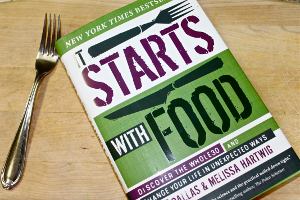 So take a few minutes to read the primers on why it’s a good idea to try going without sugar, grain, dairy, legumes, and alcohol for a few weeks. If those don’t quite push you over the edge, try reading a bit more. Then eliminate them consistently from your diet for a few weeks and test how you feel. After the program ends, try reintroducing some of those food types one by one so you can see in a tactile, practical way whether they make any difference. So take a few minutes to read the primers on why it’s a good idea to try going without sugar, grain, dairy, legumes, and alcohol for a few weeks. If those don’t quite push you over the edge, try reading a bit more. Then eliminate them consistently from your diet for a few weeks and test how you feel. After the program ends, try reintroducing some of those food types one by one so you can see in a tactile, practical way whether they make any difference.
Maybe you’ll conclude that it’s all fine, and you should just go back to eating whatever you want. But maybe you’ll discover something that’s been holding you back in your life and your health goals, something that you never would have discovered without simply testing its absence from your life for a brief window of time.
Here are my food photos for day 61: . . . Read more!
|
|
|
March 16, 2014 — 3:02 am
Back when I and my fellow participants started this Whole30 program, CrossFit South Arlington‘s coach and program leader Megan wrote, “We are starting on Wednesday, January 15th. Add 60 days and that puts the end date at 5am on Monday, March 17th.” I’ve just realized, though, that today has been my 60th day. I’ve numbered each day here in the blog as I’ve chronicled my food choices, and I’ve now double- and triple-checked the count on a calendar to be sure my numbering isn’t off — and it’s not. My first full day of following the program guidelines was Wednesday, January 15, so my 60th full day has been Saturday, March 15.
That said, I have no problem with keeping it up on Sunday as I had already planned — as I mentioned in yesterday’s post, I plan to keep experimenting within this same framework going forward, tweaking variables here and there as I go. But Sunday will be day 61.
I wrote yesterday both about some of the nutritional lessons I’ve learned during the past two months and my post-program intentions, but I still have a couple of writing assignments left. I’ll complete one today and the other tomorrow.
A final write-up on how things went; good, bad and ugly. Any suggested areas of improvement would also be great. This is basically a critique of the program along with some suggestions on how you would make this better / different if you were in charge.
Good: The biggest benefits for me have been learning how beneficial regular breakfasts and sleep are. Basic stuff, I know, but it’s no longer theoretical for me. The reading was great, although it took a lot longer than I thought it would to get through everything — even though I’d already read a bunch of it long before the program started. I particularly enjoyed the three times I shared meals with other program participants — not only because it provided a variety of good food and recipe ideas, but because it’s easier to find out via conversation what’s working, what’s failing, and how we can support each other in the road ahead than it is through sporadically reading each other’s blogs. I’d like to be part of future paleo gatherings, if anybody else in the group is game to continue them once in a while.
Bad: This was a good way of discovering where some of my biggest weaknesses still lie. I’m a world of difference away from the life of constant junk food that I once lived, and the fact that I’ve been basically “paleo” for a while and managed to do hardcore paleo for these past two months indicates that I can tame my food demons. Going without something that I might ordinarily be tempted to eat isn’t an issue. But I’m still slacking in other areas of my life. I’m not exercising nearly as much as I want. I improved my sleep schedule a little, but not a lot. The idea of making it to bed earlier than midnight at all, let alone on a regular basis, still seems worlds of possibility away.
Ugly: Some elements of the program weren’t entirely clear in advance. The CrossFit South Arlington implementation deviates from regular Whole30 rules in a few ways, like eliminating ghee basically for the duration of the program and going long stretches with total elimination of fruit and nuts. It would have been nice to know that up front, and to make such deviations clear to all participants even after the program is under way. Halfway through the program, there were still participants who had no idea that ghee was off-limits — something I had been sure to have clarified for me (pun intended?) on the first day. Definitions weren’t always clear, either. When we were told that protein was the single mandatory part of every meal and snack, and so we couldn’t have just nuts for a snack, I pointed out that this made no sense to me because nuts contain protein. It was only after this that Megan clarified that, for the program’s purposes, “protein” always means “animal protein.” That idiosyncratic use of the word would not have otherwise occurred to me, and it would probably be useful to future participants if these kinds of program-specific redefinitions are made clear from the beginning.
Here are my food photos for days 59 and 60: . . . Read more!
|
|
|
March 14, 2014 — 1:23 am
One of the remaining homework writing assignments for the double-length Whole30 program I’m finishing in the next few days is to talk about “what, if anything you learned about yourself and nutrition.”
As I mentioned way back at the beginning, I’d been sold on the (for want of a better word) “paleo” lifestyle long before the program started, but I’d never really fully committed. As I wrote then, “I’ve been eating more or less along those lines for a while now, but I’ve never really gone hardcore. Never fully given up dairy, never worried about the bits of sugar in bacon and salami, allowed myself too many periodic indulgences.”
Now I can say I’ve gone hardcore for a few weeks — at least on the dietary front — and it’s made a difference. Although the scale is still off-limits through the weekend, I feel lighter, although I’m not sure by how much. My clothes are looser. I feel more satiated more often. Any affinity for sugary snacks I still feel is sort of abstract, without any more sense of being drawn inexorably to them, whether physically or psychologically.
But what’s made the biggest difference? Giving up fruit? Giving up dairy? Giving up nuts? Giving up the traces of sweeteners in a whole bunch of products that don’t really need them? Even going so far as to give up the artificial sweeteners in gum and mints? Who can say?
So, once the program has ended I’ll keep experimenting. I’ll add back some dairy, for instance, while holding other general dietary variables constant. Then I’ll give up dairy again and, after some time has passed, add back some fruit. And so on. I won’t get to every combination of factors that I’d like to test on myself right away, but I look forward to seeing over time whether any of them has a noticeable impact on my progress and the way I feel.
Apart from dietary composition, one big difference for me has been eating breakfast every day. For most of my life, I’ve skipped breakfast — partly because I tend to stay up late and oversleep, so I’m always rushed when I finally drag myself out of bed. Breakfast is an easy casualty of a harried schedule. But breakfast was required in this program, and I feel the difference in a kind of satiation that lasts for hours, sometimes all day.
I’ve managed to move my sleep schedule a little earlier, by an hour or two, on a regular basis, but not as far earlier as I’d hoped. Still, though, I’ve been getting a full night’s sleep more often than not during these most recent weeks, and that seems to have made a difference, too. I regard this as an ongoing work in progress, and hope to move it earlier still, especially as I learn how to better balance work, freelancing, and recreation. One strategy I hope to apply is to convince myself I don’t have to finish everything at night — instead, I can go to bed without getting anything done and do the work early in the morning. I like this idea in theory, but have yet to apply it in practice.
Here are my food photos for day 58: . . . Read more!
|
|
|
March 13, 2014 — 12:50 pm
I planned to get a chunk of Whole30 program homework writing done last night, but had a power outage that lasted for nearly six hours, well past my bedtime. I can’t take time out of my work day to do it, but I can at least take a moment to post my most recent photos to stay current.
Here are my food photos for days 56 and 57: . . . Read more!
|
|
|
March 9, 2014 — 3:24 am
For three days in a row now, I’ve skipped a meal — dinner on Thursday and Friday, lunch today. I seem to have reached a point at which I just feel satiated most of the time.
Here are my food photos for days 52 and 53: . . . Read more!
|
|
|
March 6, 2014 — 11:42 pm
I spent Tuesday and Wednesday nights engaged in musical pursuits — starting with an unexpected evening of karaoke after my scheduled pub trivia night was unexpectedly canceled. Here are the three songs I performed for the crowd of mostly strangers: . . . Read more!
|
|
|
March 5, 2014 — 2:07 am
My semi-regular trivia night was unexpectedly canceled at the last minute tonight, which led to a fantastic bunless burger and karaoke with a relatively new friend and a couple of complete strangers. Nerve-wracking for an introvert, but ultimately a lot of fun.
Here are my food photos for day 49: . . . Read more!
|
|
|
|
|
March 3, 2014 — 3:54 am
Today’s homework assignment is to write a bit about the why the caloric balance hypothesis is mistaken. I already did that in some detail on day 18, but I’ll summarize it here.
For the past few decades, the hypothesis that has dominated nutritional science is the idea that we gain or lose weight based on the number of calories we consume or expend. Eat more than you exercise, you’ll get fat. Exercise more than you eat, you’ll get skinny. Easy as that. This notion is based on a superficial reading of the laws of thermodynamics, specifically the conservation of energy.
Science journalist Gary Taubes points out, though, that the scientists espousing this hypothesis have been assuming one-directional causality when they only see a demonstrated correlation. In fact, the thermodynamics equations have no arrow of causality — and we can see that the causality points in the opposite direction when we think about children growing into adults. Children going through growth spurts don’t grow because they’re eating a lot — they eat a lot because they’re growing. That growth, and the ravenous appetite it consequently brings, stems from human growth hormone.
So, contrary to the conventional wisdom that people get fat because they consume more energy than they expend, this is the alternate hypothesis: People consume more energy than they expend because they’re getting fat. That growth, and the ravenous appetite it consequently brings, stems from insulin production and resistance, which is gradually developed from excessive carbohydrate consumption — particularly refined sugars and grains. This has been borne out in controlled studies of rodent diets, and observational studies of human diets.
The insight here is that physical growth of all kinds is first and foremost a hormonal phenomenon. If your hormones are telling your body to grow, they will also give you the appetite and energy inclinations to make that growth possible.
Pinning it all on caloric balance without understanding the unique metabolic effects of different kinds of calories is to pretend that you can control a system without understanding the structural complexity underlying it.
In short, hormones are the cause, appetite is the result, growth is the effect.
Here, Taubes proposes an experiment that could definitely prove or disprove this hypothesis.
Here are my food photos for day 47: . . . Read more!
|
|
|
March 2, 2014 — 1:45 am
Meetings all day, and freelance work all night. I’ll put together something more substantive tomorrow, but in the meantime, you can see me pop up in a video shot by Washington, D.C., mayoral candidate Bruce Majors during a Saturday afternoon tour of the Libertarian National Committee’s forthcoming new office space in Alexandria, Va. (that’s me at 1:56, and my voice during the last minute or so): . . . Read more!
|
|
|
March 1, 2014 — 1:26 am
Too much to do tonight, too little time to do it. I’ll save a new substantive post for tomorrow, and hope that I don’t skimp on the sleep hours too badly tonight.
Here are my food photos for day 45: . . . Read more!
|
|
|
February 28, 2014 — 1:49 am
One homework assignment this week as part of the 60-day Whole30 program I’m participating in with several other members of CrossFit South Arlington is to review these two articles and talk about the circumstances surrounding my own food cravings:
Change Your Habits, Part 1: The Cue
Change Your Habits, Part 2: Willpower
There have been a few challenging adjustments for me during this program, but fortunately food cravings haven’t really been among them! In the food log I’ve been maintaining since the program started, I count only four instances of food cravings, all of them for some sort of sugary or even mildly sweetened food, on day 5, day 8, day 11, and day 19. None of these cravings were for a particular food — at least not strongly so. The first time it happened, the first thing I thought of that I wanted to eat was Justin’s maple almond butter, but really anything moderately sugary would have satisfied the urge.
These cravings weren’t really triggered by places, people, or events, but three of them do share one thing in common — they happened an hour or two after a lunch of just eggs and mixed greens sautéed in red palm oil. The fourth happened after a lunch that included 15 cranberries. Were the eggs and fat not quite enough to keep me satiated throughout the afternoon? Did the cranberries trigger too much insulin and lead to a sugar craving later?
The first three instances were still relatively early in this experiment so I may not have fully transitioned from sugar burning. I wasn’t eating a ton of sugary carbs, but I was eating more fruit than I should have, indulging too often in things like sweetened nut butters, and certainly not paying any attention to the small quantities of sugar in things like bacon and sausage. People transitioning into a low-carb diet often report feeling flu-like symptoms and frequent sugar cravings within the first few days. I’ve never really had it that bad, but maybe these particular cravings were kind of a low-grade version of my body suddenly adapting to having nearly zero sugar content in my diet.
In any case, I managed to overcome most strong cravings and food-related impulses a long time ago. This is not to say I haven’t ever indulged in things I believe I shouldn’t eat, but it’s not difficult for me to deprive myself of anything entirely. I started using a psychological trick way back in the mid-’90s, in my first successful (although short-lived) stab at weight loss.
First, I try to focus on the great-tasting foods that I can currently eat instead of on the foods I can’t. The old glass-half-full mentality. Quit obsessing over cookies and doughnuts, and instead remind myself that I can eat things like great steaks and curries and an array of tasty, spicy veggies. This attitude does most of the work in avoiding temptation.
Second, I try to maintain a mental mindset that any particular off-limit food isn’t actually food. So, if I see a plate of brownies, I regard them as non-consumable objects. They may as well be made out of plastic — I won’t be eating them in either case. This is pretty successful in and of itself, just refusing to regard particular kinds of food as edible at all.
If that’s not enough to prevent some kind of food from tempting me, though, my third strategy is to try calling up a tangible memory of how the forbidden food tastes, smells, and feels. In other words, I try to indulge momentarily in a brief and vivid — though imaginary — sensation of all the things I enjoy about that off-limits food. And then I remind myself: I already know what that tastes like. The experience of eating that is already stored away in my memory, ready to call back at any time. So, if I were to indulge in actually eating it again now, what would I gain from it after the few seconds of consumption had passed? Just another memory of the past, the same type of memory that I already have.
Indulging would also mean that I’ve disrupted my own health goals, and I know how easy it is for marginal choices to aggregate over time into a drastically unhealthy lifestyle. It’s better to avoid even those marginally bad choices whenever possible. I gain nothing by indulging again but regret and a fleeting sensation of the kind I can already recall at will from my memory.
That’s my three-pronged strategy for avoiding food temptation, and it’s usually very successful. I used to live a life of constant prodigious indulgence in all kinds of junk food (along with terribly unhealthy food that I assumed was good for me), and I have a detailed memory of all the qualities that I loved about it while eating it, as well as all the ways in which it made me feel terrible afterward. Calling up both of those different types of memory when needed helps to keep me safely away from the wrong foods.
Here are my food photos for day 44: . . . Read more!
|
|
|
|
|
February 26, 2014 — 1:25 am
A particularly lame article made the rounds among a dozen or so of my Facebook friends the other day, decrying the “pseudoscience” to be found at Whole Foods. The piece points out some alternative health notions that I’d agree are almost certainly bogus — like homeopathy and various mystical-sounding healing claims — but also lumps into this pile of perceived quackery things like organic vegetables and books about paleo food.
I’m not suggesting that anybody needs to hold a positive belief in the value of any of those things, but in that author’s sneering certainty that they all amount to pseudoscience — or, still more libelous, anti-science — he reveals his own ignorance of the scientific method and veers into pseudoscience himself.
In short, an untested (or little-tested) hypothesis is not the same as a false hypothesis. Most of the people seeking out better health through better nutrition, with dietary strictures that fly in the face of conventional wisdom, aren’t rejecting science. Far from it. They’re participating in a process of self-testing, determining whether the anecdotal evidence of others may also apply to themselves. They’re checking out relatively untested hypotheses on a personal, case-by-case basis. This is no substitute for the gold standard of randomized, controlled trials, but when those trials aren’t forthcoming and your own health is on the line, it’s not crazy to seek out — and test — some of those alternative solutions yourself, especially when you’ve seen widespread testimony of their effectiveness for others.
Far too often, the skeptic community that I love takes this amazingly hubristic approach, essentially treating unproven hypotheses as though they are proven quackery. Skepticism about fanciful unproven claims is great, but a sense of certainty that unproven hypotheses are false is both misplaced and pseudoscientific.
No food-related issue better illustrates this hubris than GMOs. This article targets the people who want to avoid them as part of the “pseudoscience” crowd. Generally speaking, GMOs don’t bother me. Pretty much the only reason I’d be inclined to avoid some GMOs is because they’re tailor-made to be pesticide resistent and therefore have higher pesticide residue when consumed — exactly the same reason I prefer organics for some food. It’s not necessarily a different nutrient composition that I’m after, but a lower exposure to a very particular set of chemicals.
But, apart from pesticides, GMOs seem genetically safe to me. The scientific explanation for why they should be safe convinces me, and histrionic claims about frankenfoods don’t. Still, I don’t possess certainty about my assumption. Supporters of GMOs like to assert (smugly, always smugly) that GMOs have been positively demonstrated to be safe, but it’s crucial to point out that a failure to demonstrate harm is not the same thing as proving something safe.
It’s always possible to conduct bigger, longer studies that better control for important variables, and I have no assurance that my assumption of GMO safety would be certain in every one of those cases. I oppose attempts to ban GMOs through political power, but voluntary organized attempts to avoid GMOs seem fine to me — and if those people have a lower risk tolerance than I do for specific types of food, I’m happy that they have retailers who will cater to them.
And, once again, name-calling those who have that lower risk tolerance as “pseudoscientific” is in and of itself pseudoscientific.
I have no reason to go through that article point by point, because it continually makes the same kind of errors. I’ll end on this supremely annoying quote:
If the Paleo diet helps you eat fewer TV dinners, that’s great—even if the Paleo diet is probably premised more on The Flintstones than it is on any actual evidence about human evolutionary history.
As it’s been pointed out again and again and again, historical reenactment is not the point. The little we know about the history of diet in human evolution is only a starting point for suggesting testable hypotheses about foods that are better or worse for us to consume. So, no, “paleo” diets aren’t any more genuinely “paleo” than all comic books are genuinely comical. It’s an imperfect term that stuck, and pretending that word is intended to be literal misrepresents the actual research that’s ongoing.
Here are my food photos for days 41 and 42: . . . Read more!
|
|
|
February 23, 2014 — 9:37 pm
On day 32 of this Whole30 program, I wrote about a new bedtime routine that I was trying out a few nights each week in order to get to bed earlier. (I also pointed to a great article from Mark Sisson about sleep strategies on day 37.)
I think the routine is helping to wind me down and successfully relax so that I fall asleep quickly after I go to bed, which is great — and I’ve been getting about eight hours of sleep more often than not lately, which is one of the biggest goals here.
The new routine hasn’t helped yet, though, in actually getting me into bed much earlier on a regular basis. In fact, I think it’s contributing to me staying up a little later. Because this routine focuses on turning out or dimming all lights and unplugging from devices for a period of time before going to bed, I often end up working on freelance projects up until the point that I’d like to just fall asleep, then the bedtime routine of unwinding before going to bed keeps me up that much longer — albeit in a more relaxed and ultimately sleep-receptive state.
I think it’s a success overall so far, in that it’s getting me a better quantity of solid sleep hours, but I still need to work on task prioritization so that I can keep to a more consistent earlier bedtime and earlier rising without sacrificing the amount of time I’m actually asleep. It’s still a balancing act.
Here are my food photos for day 40: . . . Read more!
|
|
|
February 23, 2014 — 2:13 am
This marks two weekends in a row of extended interaction with strangers — pretty far outside the introvert comfort zone. It all turned out well, though, and today’s two separate paleo potluck gatherings provided the opportunity to sample several excellent recipes that I’d enjoy adding to my own routine at some point.
First, a few of the folks participating with me in CrossFit South Arlington‘s double-length version of the Whole30 program organized a late-lunch potluck at the same location and with some of the same attendees as our shared paleo meal on day 18. Here’s the spread and the group: . . . Read more!
|
|
For more good ol' fashioned ranting and raving, visit the archives!
|